How to Tell If Your Lawn Needs More Sunlight
One section of your lawn may be thick and green while another remains thin no matter how much attention you give it.
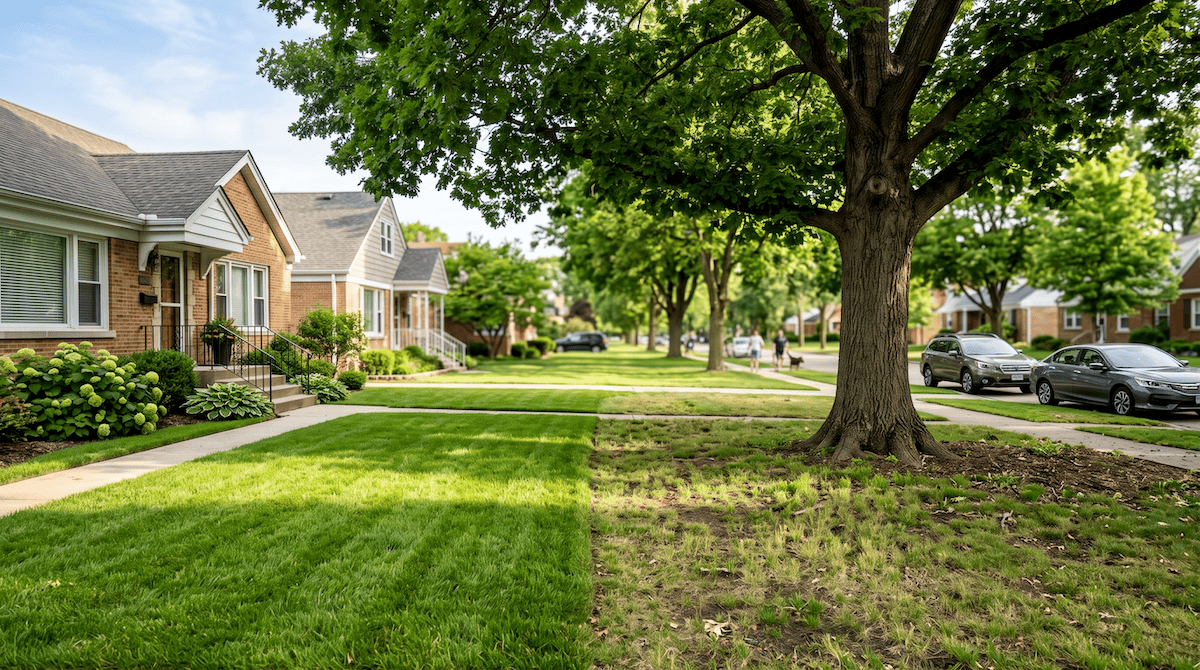
One section of your lawn may be thick and green while another remains thin no matter how much attention you give it.
If the struggling area is underneath trees, next to a building, or behind a fence, sunlight may be the missing ingredient.
Grass needs light to produce the energy required for healthy growth. When turf doesn't receive enough sunlight, it can become thin, weak, and increasingly vulnerable to other problems.
Look at the Pattern
Shade-related lawn problems often have a recognizable pattern.
Grass may become thinner as you move toward a large tree or structure.
You may also notice that one side of the lawn performs significantly better than another.
This is an important clue.
If fertilizer and watering are relatively consistent across the property but one area continually struggles, sunlight should be considered.
Trees Change Over Time
A property that had plenty of sunlight ten years ago may have much more shade today.
Trees grow.
Branches become wider and denser. As the canopy expands, less sunlight reaches the turf below.
This can gradually change the conditions of the lawn without homeowners realizing why.
Morning and Afternoon Sun Are Different
Not all sunlight exposure is equal.
A lawn that receives several hours of direct morning light may behave differently from one that receives only filtered light throughout the day.
The amount of direct light, duration of exposure, and density of surrounding vegetation all matter.
Don't Automatically Remove Trees
If grass struggles underneath a mature tree, removing the tree is not necessarily the answer.
Trees provide shade, environmental benefits, and value to a property.
Instead, homeowners should first determine whether the existing grass variety and maintenance strategy are appropriate for the amount of light available.
Consider the Whole Environment
Shade isn't the only factor.
Tree roots compete with grass for water and nutrients. Falling leaves can cover turf. Soil beneath mature trees can also become compacted.
That means shaded lawn areas often require a different management strategy.
When Grass Simply Isn't the Right Choice
Sometimes the most practical answer is that a particular location doesn't receive enough sunlight to support dense turf.
In those areas, homeowners may consider alternative landscaping approaches rather than repeatedly trying to force grass to grow where conditions are unsuitable.
The first step is understanding the cause.